Start with the complete result
The mowing time is only one input. Before choosing a price, write down what the customer will receive: which lawn areas, whether edging and a final tidy are included, which garden beds or hedges are in scope, and exactly what happens to the green waste.
A written quote should make the work, costs and terms clear. Australian Government guidance says a good quote is clear, specific and complete, with a description of the work, itemised and total costs, applicable GST, timing, expiry and acceptance details. That guidance does not set a gardening rate for you.
Inspect the work before you count the hours
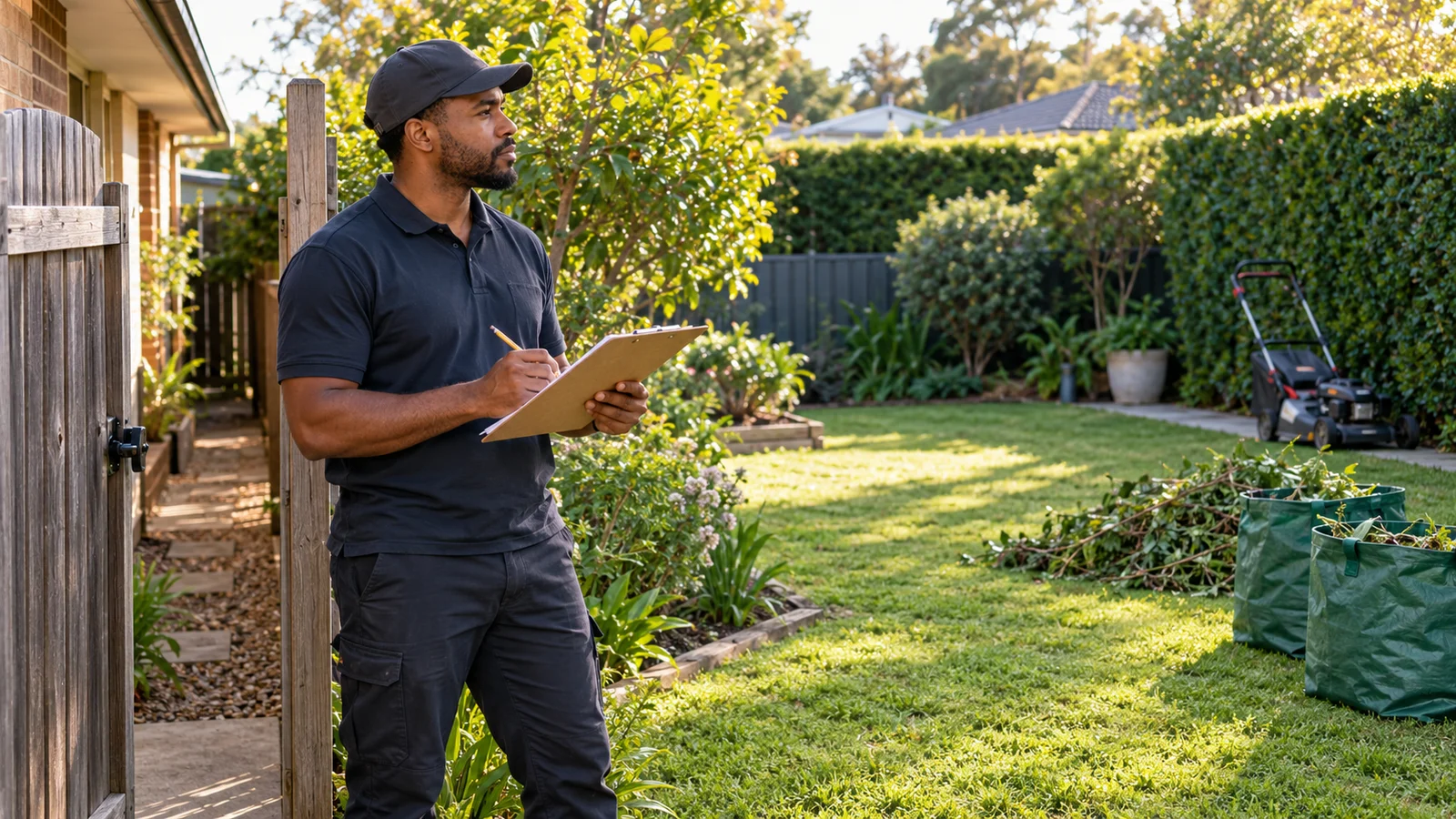
Walk the route that the work will take, not only the lawn. A narrow gate, stairs, a steep section or a long carry to the vehicle can change the labour and equipment needed. Record uncertain details as assumptions for the customer to confirm rather than quietly absorbing them.
- •Access: gate width, steps, slope, parking and carry distance
- •Condition: grass height, wet ground, hidden objects and obstacles
- •Equipment: what must be unloaded, set up, cleaned and loaded again
- •Waste: quantity, handling, transport and the current receiving facility
- •Customer decisions: areas or optional work that still need confirmation
Use this whole-job worksheet
Copy the lines below into your estimating sheet. Use your own measured costs and rate; do not copy someone else's public price and assume it covers your business.
- •On-site labour: mowing, edging, pruning, weeding, tidy-up and customer handover
- •Setup and pack-down: unloading, equipment preparation, cleaning and loading
- •Allocated travel: the portion of the run required to reach this property and the disposal point
- •Materials: plants, mulch, chemicals or consumables that are actually included
- •Disposal: handling time and the current fee and acceptance rules at the chosen facility
- •Vehicle and equipment allowance: costs your own pricing method allocates to the job
- •Overheads and profit: added once, using a method you understand
- •Applicable GST and customer-facing total
Worked example with fictional inputs
This example demonstrates arithmetic only. The $60 internal costing rate, $15 materials allowance, $25 facility allowance, $10 vehicle allocation and 20% markup are invented. They are not market rates or a recommendation.
The operator allows 1.5 hours on site, 0.25 hours for setup and loading, and 0.5 hours of allocated travel and disposal time: 2.25 hours × $60 = $135. Add $15 materials, $25 disposal and $10 vehicle allocation for a $185 cost subtotal. A 20% markup on cost adds $37, producing an illustrative $222 before applicable GST.
A 20% markup is not the same as a 20% profit margin. Check whether your labour rate already includes overhead before adding it again, and replace every fictional number with your own current evidence.
Separate scope, assumptions and optional work
A customer should be able to see what the amount covers and what would require a change. For the fictional example, the fixed scope might be the agreed lawn areas, edging and removal of one described quantity of green waste.
- •Assumption: the photographed gate provides the access discussed
- •Assumption: the waste quantity does not exceed the stated allowance
- •Excluded: hedge reduction, tree work, chemicals and unidentified extra waste
- •Optional: separately priced garden-bed work only after the customer accepts it
If the scope changes, pause and agree on the variation before doing the extra work. That is clearer than relying on an unspoken assumption at the end of the visit.
Turn the worksheet into a readable written quote
Use plain language and keep the customer's decision visible. Include your business and contact details, the customer's details, the exact work and exclusions, itemised and total costs, applicable GST, proposed timing, payment terms, expiry and a way to accept. If a disposal fee or material quantity is provisional, label the basis and how a change will be approved.
Check whether the visit fits the day
Pricing the job and fitting it into a run are separate decisions. After you have a realistic time allowance, place that proposed visit beside your existing commitments and travel. If it does not fit, change the proposed day or scope before promising a time.
DayRoute's free web planner can compare a proposed order for up to 10 jobs using Google Maps travel estimates. It requires email sign-in and currently allows 10 successful calculations per account; recalculating uses another calculation. It does not create the gardening quote, enforce appointment windows or prove that your price is profitable.
Does the quoted visit fit the rest of the day?
Use the free web planner for a bounded route-order check after you have estimated the job. It plans up to 10 jobs and does not replace your quote or customer agreement.
Sources and scope
- Australian Government — Prepare quotesReviewed 27 October 2026 for written quote structure, scope, itemised costs, terms, timing, expiry and acceptance. It does not set gardening prices.
- Australian Government — Choose a pricing strategyReviewed 27 October 2026 for cost-plus inputs and the need to cover relevant costs. It does not establish a suitable rate or margin for this fictional example.
- DayRoute product factsDirect product evidence for the current free planner limits and travel-estimate scope. It is not evidence about gardening prices, disposal costs or profitability.